
How Jazz Changed Today’s National Anthem Performances
There is nothing more American than Fourth of July fireworks, “The Star-Spangled Banner,” and jazz. Indeed, celebrating the country is done best alongside America’s only original art form. As we celebrate America’s 250th Birthday lets take a look at the role jazz has played in the celebration of our country and how it has evolved over the years.
While “The Star-Spangled Banner” has been a consistent staple of Fourth of July and American celebrations since its creation in 1814, it has also been the subject of constant change. Today, most people are used to musical artists putting their own spin on the national anthem, and audiences almost expect to hear the national anthem in a style that it was not intended to be played in. It seems that any variation of the anthem is possible to hear now, whether it’s loud or soft, instrumental or vocal, electric or acoustic, modern or traditional, even rock or pop. The anthem has become a rich opportunity for musicians to express themselves.
However, it didn’t used to be this way. In the past, musicians were heavily ridiculed for playing the national anthem outside of the traditional, marching style. It wasn’t until jazz musicians were brave enough to change what it means to play this song that the national anthem began to see variations in its performance.
First Steps
This change began in the 1940s and 1950s, when jazz was slowly moving from dance halls into America’s most prestigious concert venues. As the music gained recognition, legendary performers such as Duke Ellington, Dizzy Gillespie, Nat King Cole, and Louis Armstrong were increasingly invited to perform the national anthem before festivals, sporting events, and major public gatherings.

Ellington and Armstrong made the national anthem a regular occurrence at the beginning of their performances during this time. In 1958, Gillespie and Armstrong proudly opened the very first Monterey Jazz Festival and the fourth Newport Jazz Festival, respectively, with solo-trumpet performances of the national anthem. The performances, while strong, had not yet fully explored the potential of musical variations of the national anthem. Yet, they were important for furthering the legitimacy of jazz and allowing it to be seen as a high-brow art form on-par with classical or marching music. This was especially the case when Ellington performed the anthem at the prestigious Carnegie Hall in 1943, which showed the American public that fancy, “traditional” settings, and songs such as “The Star-Spangled Banner,” did not have to be restricted to one genre or type of venue.
A Turning Point
National anthem performances changed forever after Jose Feliciano sang his Latin, folk-jazz interpretation of the anthem on first base at Game 5 of the 1968 World Series. The interpretation was slow, intimate, and personal. It featured no brass band or soaring vocals, and instead featured Feliciano’s unique vocals on an acoustic guitar. While Feliciano himself is not strictly a jazz musician, he has openly taken inspiration from jazz greats who came before him such as Django Reinhardt, and that jazz influence on this performance was undeniable.
The criticisms were immediate and intense. Calls were made to the television station to complain. Feliciano was blacklisted for months. Audiences were so scandalized by the idea of the anthem being performed so unconventionally that it caused severe damage to Feliciano’s career. Despite this, it ushered in an era of heavily personalized and stylized versions of the national anthem that are more commonplace today. This era came quickly, as the very next year Jimi Hendrix would perform his iconic, improvisational, rock version of the national anthem at Woodstock.
Modern Styles and Variations
By the 80s, jazz musicians weren’t seen as challengers of tradition anymore, and began to rise in prominence as national anthem performers.
In this decade, jazz musicians Wynton Marsalis and Herb Alpert played the national anthem on their trumpets in 1986 and 1988 respectively at the Super Bowl. Marsalis reintroduced the idea of playing the anthem instrumentally at the Super Bowl, as he was the first person to do it in over a decade. His brother, Branford Marsalis, would go on to create a Grammy-award winning instrumental jazz national anthem rendition in 1994.

This era also saw an increase in the national anthem being played across many genres, including those that evolved from jazz such as R&B and soul. This was most clearly on display with Marvin Gaye’s 1983 NBA All-Star Game performance, where he sang the anthem as a slow, R&B ballad over a prerecorded synthesizer and drum track. These variations on the anthem, as opposed to previous decades, were now able to be met with critical acclaim and appreciation.
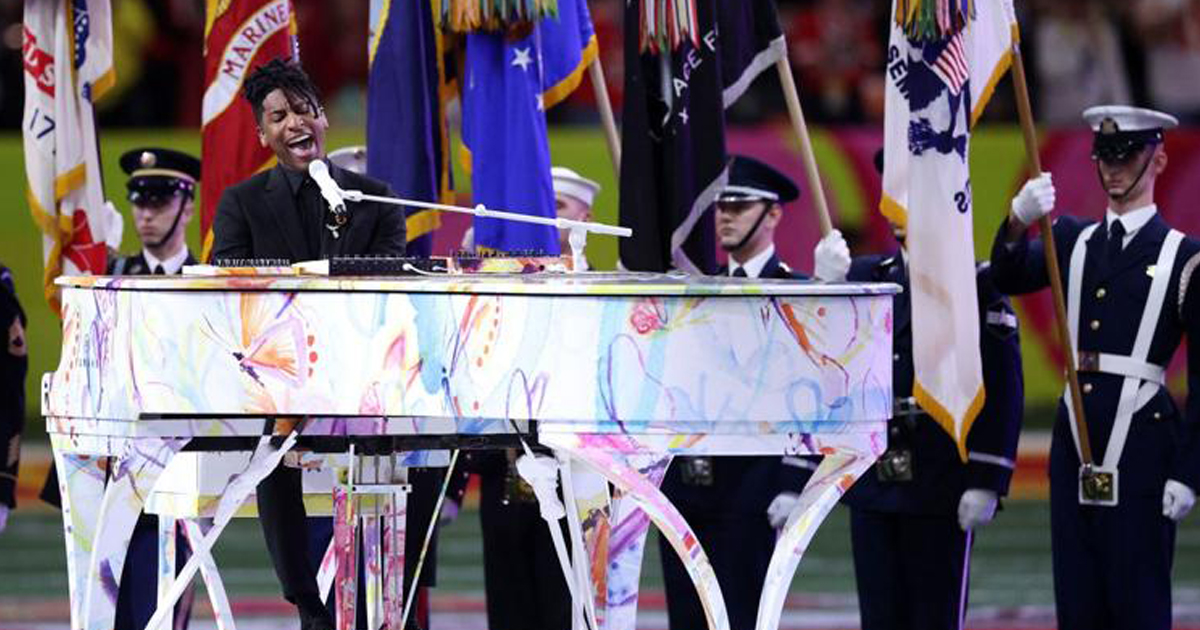
Today, there is no stigma around playing the anthem in a personal way. Whether the musician performs country, pop, or rock, audiences often anticipate for them to put their own spin on it. This was the case for Jon Batiste’s Super Bowl performance in 2025, which drew from New Orleans-style jazz as a tribute to the city that the game was held that year, and to his New Orleans heritage. This rendition is one of the most unapologetically jazz variations of “The Star-Spangled Banner,” and it would not exist without the performances that came before it.
Appreciating Jazz History
Every time an artist adds a personal touch to the national anthem today, they are participating in a tradition that jazz helped create. Without the iconic national anthem performances from jazz legends of the past, we would not have the many ambitious, innovative, and sometimes controversial versions that we hear today. Jazz paved the way for iconic and influential modern national anthem performances across many genres.
America’s musical landscape has changed significantly since the country’s founding 250 years ago. In many ways, the jazz musicians who dared to create musical and cultural change in the United States could be seen as musical revolutionaries or patriots. Is there anything more fitting to appreciate on the Fourth of July?
The JazzArts team would like to say, happy 250 America! Keep Swinging!